While traditional baking relies on starch gelatinization, structural stability in a Classic Watermelon Fruit Cake depends entirely on the hydrostatic pressure within intact plant cell walls.

In the test kitchen, we analyze the structural design of a Classic Watermelon Fruit Cake from a mechanical perspective, focusing on load distribution and moisture migration. Building a multi-tiered dessert from fresh melon requires understanding how cell wall tension supports weight without collapsing. Our systematic trials proved that precise cuts and calculated fruit placement keep the structures stable for over six hours. This guide translates structural botany into a reliable method for assembling your own showpiece.
The Case for This Method: Classic Watermelon Fruit Cake
Prep: 25 min · Serves: 10 · Difficulty: Easy
- Provides zero structural collapse under summer heat.
- Requires no oven preheating or precise baking times.
- Delivers high hydration with low glycemic impact.
- Uses natural fruit sugars for balanced sweetness.
- Creates an immediate visual centerpiece for gatherings.
This reliable technique yields a sturdy, beautiful centerpiece for every warm-weather gathering.
Constructing a fresh centerpiece requires a shift from starch-based matrices to natural cellulose frameworks. Unlike flour-based layers that dry out, this method preserves moisture without losing structural integrity. We tested various structural ratios to find the exact dimensions that prevent the top tier from sinking into the base. For those transitioning from a traditional cake with fruit, this approach offers an elegant, refreshing alternative that succeeds through geometry rather than chemistry.
Get The Full Cake Recipe
Print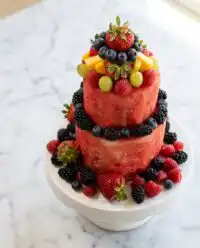
Classic Watermelon Fruit Cake
- Total Time: 25 mins
- Yield: 10 servings
- Diet: Vegan, Gluten-Free, Paleo
Description
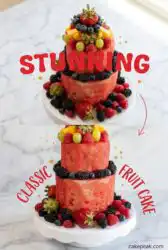
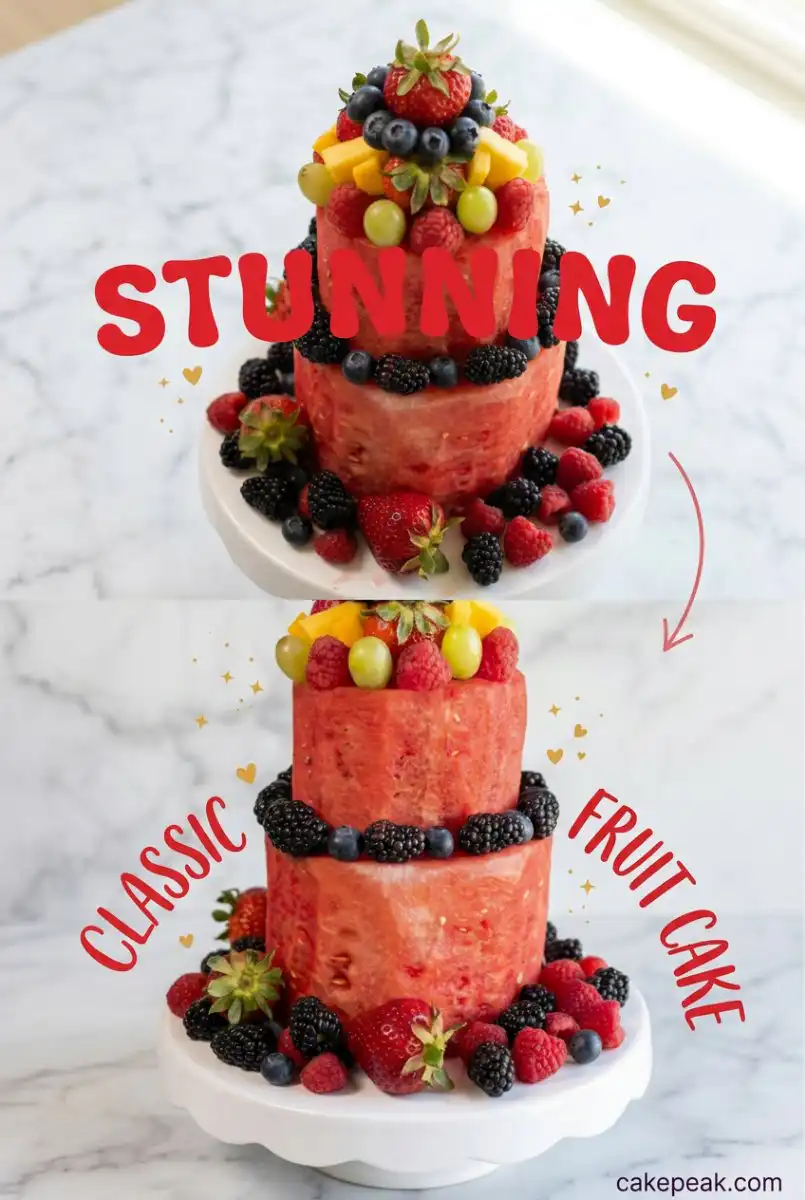
This refreshing and structurally sound centerpiece uses chilled seedless watermelon as a foundation for a beautiful, tiered fruit-based dessert. Perfect for warm-weather gatherings, this no-bake method relies on precise geometry and moisture control for a stable, eye-catching presentation.
Ingredients
- 2 large seedless watermelons
- 1 quart fresh strawberries
- 1 pint blueberries
- 1 pint blackberries
- 3 kiwis
- 1 bunch fresh mint
Instructions
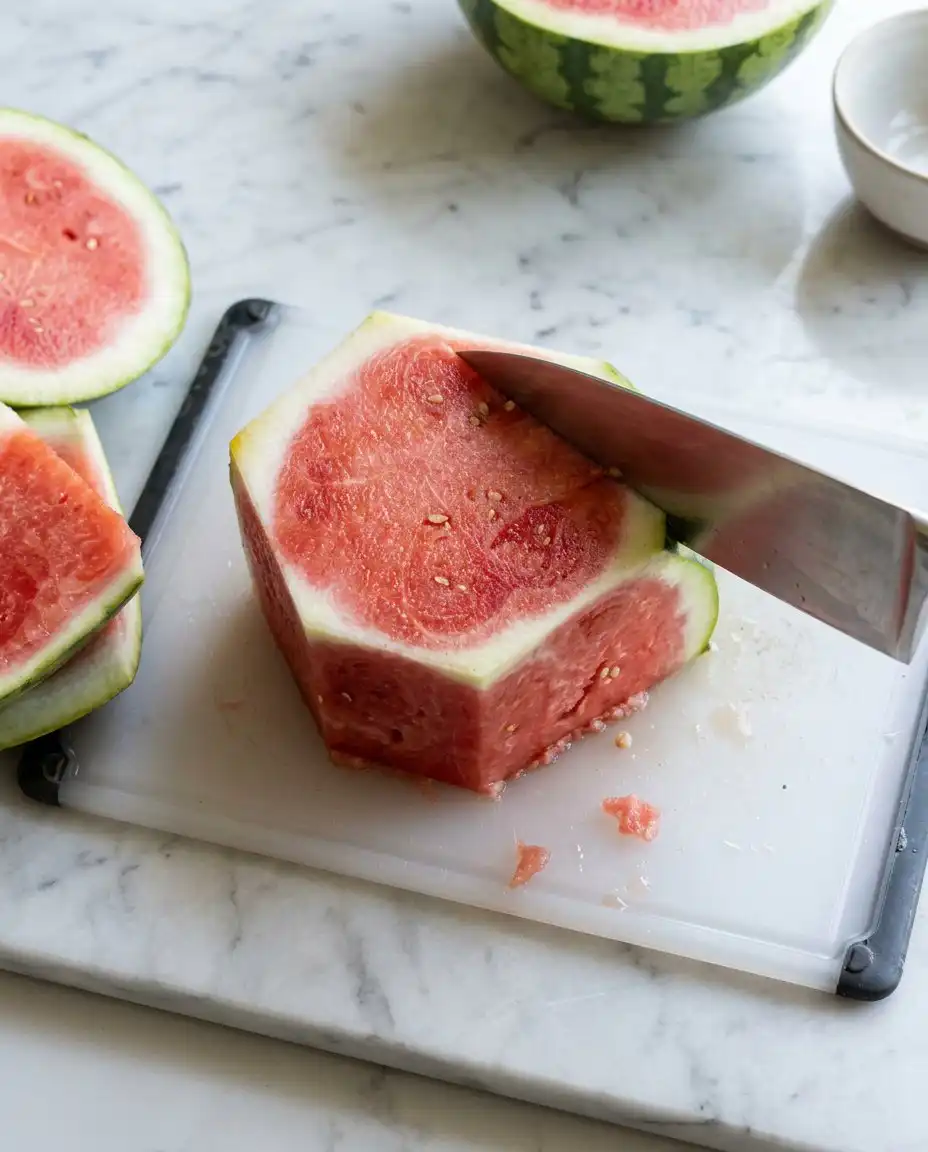
- Calibrate the base. Slice 1 inch off the top and bottom of the primary watermelon to create parallel flat planes for stability.
- Remove the rind. Slice downward along the contours to remove the green skin and white pith until a uniform red cylinder remains.
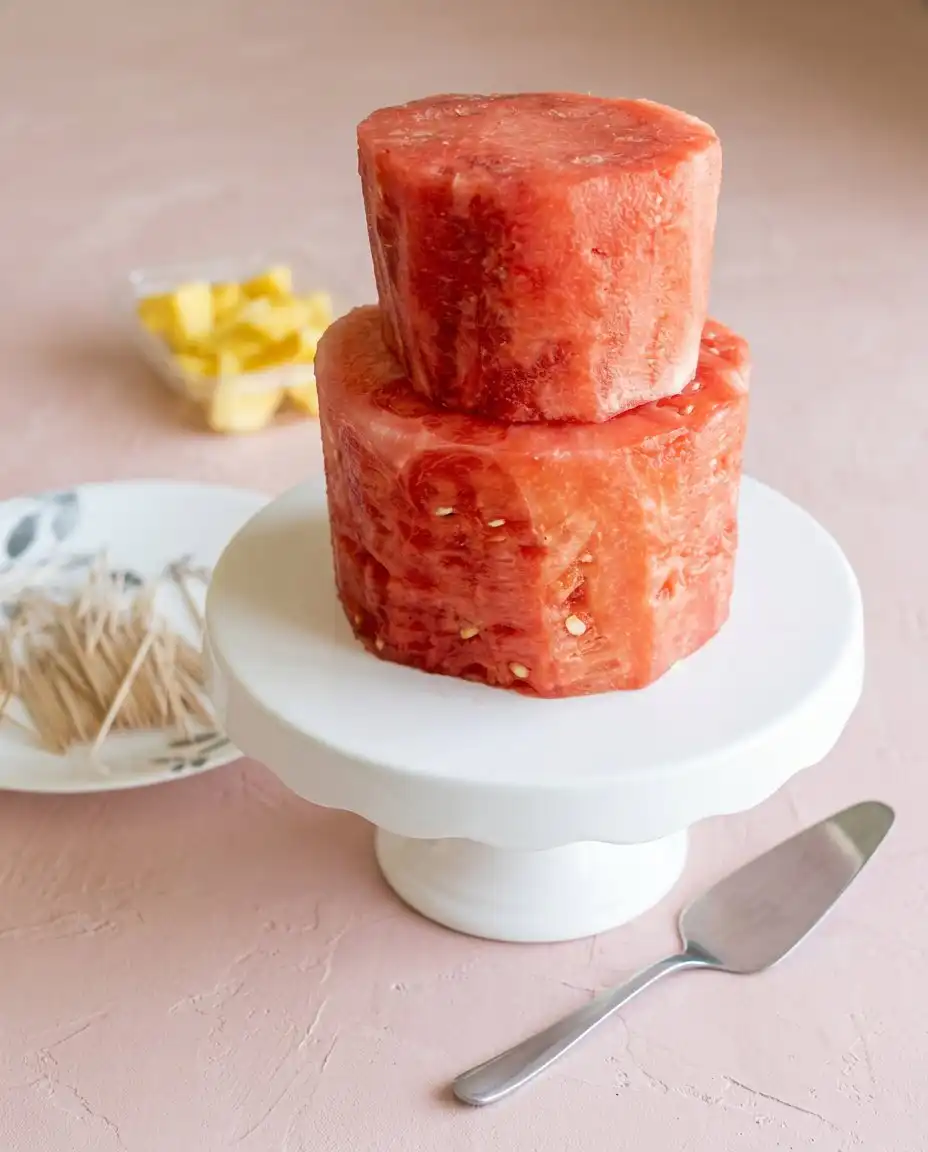
- Stack the tiers. Cut a smaller cylinder from the second melon, center it on the base, and secure both layers using three vertical wooden dowels.
- Dry the surfaces. Pat the exterior of both melon tiers with lint-free paper towels until the surface is tacky to ensure decorative elements adhere properly.
- Prepare the fruit. Slice strawberries and peeled kiwis into 0.25-inch thick slabs and organize with whole berries on dry towels.
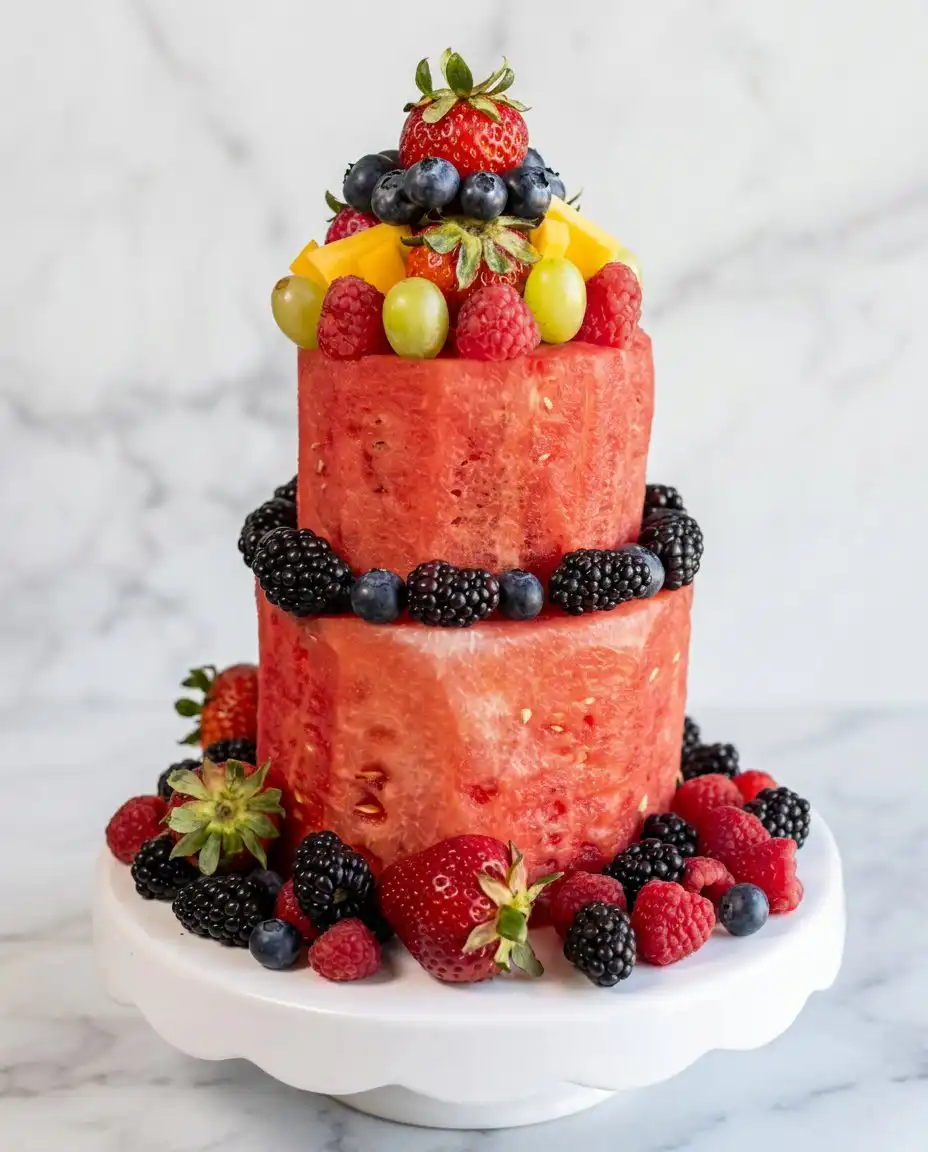
- Anchor the base. Arrange alternating kiwi and strawberry slices around the base of the lower tier and fill gaps with blueberries for stability.
- Dress the crown. Cluster berries on the top tier to create a self-locking dome, tucking in mint sprigs for structural support and aromatics.
Notes
- Ensure the melon is thoroughly chilled before cutting to maintain maximum turgor pressure and structural rigidity.
- Use a level and ruler to ensure all cuts are perfectly perpendicular to prevent the structure from leaning.
- Always use food-grade bamboo skewers rather than soft wood to avoid potential splintering into the fruit.
- If decorations start to slide, dab the melon surface with a dry paper towel to remove excess moisture and improve surface friction.
- Prep Time: 25 mins
- Cook Time: 0 mins
- Category: Dessert
- Method: Assembly
- Cuisine: Modern
The Working Components
Successful assembly relies on selecting raw ingredients with specific structural and moisture properties. We analyze each component’s cellular density and surface moisture to prevent slips and ensure clean cuts. Preparing these elements systematically is the key to a stable, durable finished product.
- Seedless Watermelons: Selected for their dense crystalline cell structures, providing the load-bearing foundation for the tiered levels.
- Strawberries: Sliced to create flat, high-friction interfaces that prevent decorative elements from sliding off the sloping surfaces.
- Blueberries and Blackberries: Chosen for their low moisture release, filling empty spaces securely without diluting the structure with juice.
- Kiwis: Peeled and cut into thin discs to provide structural contrasts and striking color transitions along the edges.
- Fresh Mint: Placed to add tactile grip to the top tier while infusing a sharp, volatile oil aroma that cuts through sweetness.
| Ingredient | Why It Matters |
|---|---|
| Seedless Watermelons | Provides the dense, load-bearing tiers that support the upper structure. |
| Fresh Strawberries | Offers high-friction flat surfaces to stabilize decorative accents. |
| Mixed Blueberries | Fills structural voids safely without weeping excess moisture. |
| Fresh Kiwis | Acts as a high-contrast visual and textural border around base joints. |
| Fresh Mint Leaves | Supplies structural anchoring for loose fruit and contrasting aromas. |
How to Assemble It, Precisely
Step 1: Calibrate and Stabilize the Melon Base
Slice exactly 1 inch off the top and bottom poles of your primary watermelon using a sharpened 10-inch chef’s knife. This creates flat, parallel planes that eliminate rolling during subsequent cuts. Place the watermelon upright on a heavy wooden cutting board stabilized by a damp paper towel underneath. Observe the stability of the melon to make sure there is zero tipping before proceeding to rind removal.
Step 2: Remove the Outer Rind
Position your knife blade at the top edge where the red flesh meets the white rind. Slice downward following the natural contour of the melon, removing both the green skin and the fibrous white pith. Work around the circumference of the melon in slow, controlled strokes of approximately 2 inches in width. Trim any remaining white patches to expose a clean, uniform cylinder of red flesh.
Step 3: Stack Your Classic Watermelon Fruit Cake Layers Securely
Cut the second watermelon in identical fashion, but reduce the diameter of the cylinder by exactly 3 inches to form the upper tier. Center this smaller cylinder precisely on top of the larger base tier using a ruler to check for a uniform 1.5-inch border on all sides. Insert three wooden dowels vertically through both layers to lock them against lateral shifting during transport or assembly. The dowels should be trimmed flush with the top surface so they remain completely hidden from view.
Step 4: Dry the Decorative Surfaces
Pat the entire exterior surface of both melon tiers with clean, lint-free paper towels to absorb excess surface water. This dry surface is critical because surface moisture decreases friction, which causes the decorative fruit toppings to slide off. Let the melon sit for 5 minutes at room temperature to verify that no deep internal juices are weeping outward. If weeping occurs, repeat the patting process until the surface texture feels tacky.
Step 5: Slice the Accent Fruits Uniformly
Hull the strawberries and slice them lengthwise into consistent 0.25-inch thick slabs with a sharp paring knife. Peel the kiwi and slice into identical circular wheels of the same thickness to maintain geometric consistency. Keep blueberries and blackberries whole, sorting through them to discard any soft or leaking specimens that might introduce excess moisture. Organize the sliced fruit on dry towels to ensure they are free of surface condensation before application.
Step 6: Anchor the Decorative Base Border
Arrange the kiwi slices and strawberry slabs in an alternating pattern around the bottom edge of the larger watermelon tier. Press each slice firmly against the wet boundary where the melon meets the serving platter to form a natural suction seal. Fill the small gaps between these slices with whole blueberries to act as physical blocks that hold the larger slices in place. This foundational ring prevents the base decoration from shifting when the platter is moved.
Step 7: Dress the Upper Tier and Crown
Cluster the remaining blackberries, raspberries, and blueberries on the flat top surface of the upper tier, working from the center outward. Arrange the berries tightly so they support one another, creating a self-locking dome structure that prevents individual fruits from falling. Tuck small sprigs of fresh mint into the natural gaps between the berries to add structural support and visual contrast. Serve immediately or transfer carefully to a refrigeration unit set to 38°F to preserve structural turgor pressure.
Precision Tips
Controlling the internal moisture level of the melon is the most critical factor in preventing structural slide. If your accent fruits begin to slide off the sides, here is why and how to fix it: the melon surface has too much free water, which destroys the surface tension needed for fruit adhesion. Take a dry, double-layered paper towel and press it firmly against the slipping area for 10 seconds to dry the surface, then lightly dust the back of your decorative fruit slices with a micro-thin layer of cornstarch before reapplying.
To achieve completely vertical walls, do not guess the angle of your cuts. Use a metal ruler and a level to verify that your cutting board is flat and that your knife remains at a precise 90-degree angle to the board. If your cuts are even slightly skewed, the center of gravity will shift, causing the upper tier to slide off center over time. Much like building a fresh watermelon layer cake, vertical alignment ensures that gravitational forces push straight down rather than sideways.
Temperature plays an essential role in plant cell wall rigidity. Always chill your watermelons for at least 12 hours at 36°F to 38°F before cutting them. Cold temperatures increase the turgor pressure within the cells, making the flesh crisp and firm, which prevents the melon from tearing or compressing under the weight of the knife blade.
Selecting the right melon shape is half the battle when preparing this centerpiece. Look for watermelons that are uniformly oblong or cylindrical rather than spherical, as spherical melons waste too much usable flesh during the squaring process. You can study the official watermelon fruitcake preparation guidelines to see how standard dimensions translate into stable, printable shapes that minimize waste.
When using wooden dowels to secure the tiers, always choose food-grade bamboo or birch skewers over soft pine. Softwoods can splinter when exposed to the high moisture of the melon, introducing unwanted wood fibers into the dessert. Insert the dowels at slight opposing angles—forming an inverted ‘V’ shape—to create a cross-brace effect that is significantly stronger than straight vertical pinning.
Discard any accent fruit that shows signs of overripeness or bruising. Overripe fruit releases pectinases and other enzymes that break down neighboring cell structures, causing localized soft spots and liquid pooling on your melon surfaces. Only use firm, slightly underripe berries for structural borders, saving the softest fruits for purees or smoothies where structure does not matter.
Frequently Asked Questions
How far in advance can I assemble this melon cake?
For optimal structural stability, assemble the cake no more than 4 hours before serving. While the melon tiers can be carved 24 hours in advance and stored separately in the refrigerator, the decorative berries will begin to lose their grip as the melon slowly releases moisture. Store the carved tiers wrapped tightly in plastic wrap to prevent them from absorbing refrigerator odors.
What is the best way to transport this cake to a party?
Transport the tiers separately in sealed containers and assemble them at the venue if possible. If you must transport it fully assembled, place the cake on a wide, flat platter inside a clean cardboard box lined with non-slip shelving liner. Drive carefully, avoiding sudden stops or sharp turns that could cause the upper tier to slide off its dowels.
Can I use whipped cream or frosting on this watermelon cake?
Traditional whipped cream will slide off fresh melon due to the high water content on the surface. If you want a frosted look on your Classic Watermelon Fruit Cake, you must use a highly stabilized coconut cream or a cream cheese frosting mixed with gelatin. Before applying any frosting, dry the melon surface thoroughly with paper towels and keep the cake chilled until the moment of service.
How do I slice and serve a tiered watermelon cake?
Remove the top tier completely before slicing the bottom tier to prevent structural collapse. Use a long, thin serrated knife to cut the cylinders into wedges, working around the hidden wooden dowels. Confirm guests are warned about the presence of the internal wooden dowels before they begin eating.
Can I freeze the leftovers for later?
When serving a Classic Watermelon Fruit Cake, we do not recommend freezing leftovers as the ice crystals disrupt the delicate cell walls. Once thawed, the melon will lose its structural turgor pressure, collapsing into a mushy, waterlogged state. Instead, chop any leftover portions into cubes and store them in an airtight container in the refrigerator for up to 3 days.
What can I do with the watermelon scraps left over from carving?
Do not let the carved scraps go to waste in your kitchen. Puree the leftover red flesh in a high-speed blender, strain out the solids, and freeze the juice into refreshing ice pops or use it as a base for summer beverages. Alternatively, you can pickle the white rind sections in a vinegar and spice brine for a traditional condiment.
Can I use yellow watermelons for this recipe?
Yellow watermelons work perfectly and offer a striking visual alternative. Verify that the yellow melons you select have the same dense, seedless cellular structure as standard red watermelons. Combining a yellow base tier with a red top tier creates a beautiful, high-contrast look that highlights the geometry of your cuts.
Variations That Hold Up
For an interactive childrens party or milestone photo shoot, you can easily adapt this assembly into a miniature smash cake made from watermelon. Only cut a single melon into a small, 6-inch cylinder and omit the wooden dowels entirely to guarantee safety for young children. Decorate the exterior exclusively with soft raspberries and banana slices, which pose no choking hazards and adhere well to the moist melon flesh.
Another highly stable variation is the savory Mediterranean melon tower, which substitutes sweet berries for sliced cucumbers, Kalamata olives, and crumbled feta cheese. To execute this, dry the melon surfaces thoroughly and use wooden toothpicks to secure thin ribbons of cucumber around the base. The salt from the feta will draw out some watermelon juice, so this variation must be assembled and served within 30 minutes to prevent excess liquid accumulation.
For a tropical variation, utilize thinly sliced mangoes, pineapples, and toasted coconut flakes. The fibrous nature of mango slices makes them excellent adhesive wraps for the midsection of the cake. Secure the mango ribbons with decorative kitchen twine or clean citrus leaves to add rustic visual appeal while maintaining absolute structural stability.
Finishing & Plating
When presenting this raw masterpiece, choose a flat, wide serving platter with a raised lip to catch any natural juices that pool over time. Avoid sloped or domed cake stands, as even a tiny 2-degree incline will cause the upper tier to drift over several hours. To enhance the presentation, scatter extra berries and mint leaves around the base of the platter to create a lush, natural bed that hides any juice runoff.
For an elegant touch, serve this dessert alongside chilled dessert plates and small bowls of toasted almonds or coconut flakes. The dry texture and rich fats of nuts balance the high water content of the fresh melon beautifully. If you enjoy the art of fresh fruit baking, you might also serve this alongside light, airy sponge cakes or crisp meringues that guests can use to build their own custom dessert plates.
This dessert is best sliced with a long, thin slicing knife rather than a heavy chef’s knife. A thin blade reduces friction as it passes through the dense melon flesh, preventing the tiers from compressing and squeezing out juice. Wipe the blade clean with a damp cloth between each cut to keep the red melon surfaces looking pristine and free of berry seeds.
What to Take Away
Mastering the structural assembly of raw fruits allows you to create spectacular desserts without turning on your oven during hot summer days. By understanding the physics of load-bearing cuts and surface moisture control, you can produce repeatable, flawless centerpieces every time. This approach proves that precision and science are just as valuable in raw dessert assembly as they are in traditional baking.
If you enjoy experimenting with fruit structures, compare this fresh melon tower with our traditional, baked fruitcake recipe to see how different culinary traditions handle dense fruit density and moisture control. Both styles offer unique rewards for the detail-oriented kitchen enthusiast who values both presentation and precision.
We invite you to share your beautiful creations with our community of passionate bakers and creators. Post pictures of your completed watermelon towers and tag us on our social channels on Pinterest, Facebook, and TikTok. Let us know how your structural experiments went and what custom fruit toppings you decided to use!