During our rigorous testing phase for this Crepe Cake, we discovered that resting the batter for exactly 60 minutes isn’t just a suggestion; it is a structural necessity. By allowing the flour to fully hydrate, we achieved a lace-like edge and a tender bite that held up perfectly against the heavy chocolate cream. This technical precision makes certain every layer is uniform and strong enough to support the weight of the assembly.

This French-inspired dessert consists of twenty delicate crepes layered with a stable chocolate whipped cream and finished with a rich 70% dark chocolate ganache. It is a masterpiece of texture that requires patient heat management and consistent batter volume. Once you master this method, you will have a reliable foundation for creating professional-grade layered desserts in your own kitchen.
The Chemistry of a Perfect Crepe Cake
Success with this recipe comes from understanding the interplay of fats and proteins. We found that 800 ml of full-fat milk provides the exact lipid ratio needed for a pliable crepe that won’t tear during the stacking process. This specific fat content creates a barrier against moisture, meaning your cake won’t turn into a soggy mess even after 24 hours in the refrigerator.
The structural integrity of the cake relies on the protein in the four large eggs. These eggs act as the ‘glue’ that binds the 305 grams of flour, creating a network that is flexible yet sturdy. By weighing your ingredients, you verify that the viscosity of the batter remains constant, leading to crepes of identical thickness. This uniformity is what allows the final cake to stand tall without leaning or sliding.
Print
Crepe Cake
- Total Time: 4 hours 15 mins
- Yield: 12 servings
- Diet: Vegetarian
Description
Experience the ultimate French-inspired dessert with this meticulously tested twenty-layer crepe cake. Featuring delicate, lace-edged crepes layered with a stable cocoa-infused whipped cream and topped with a decadent 70% dark chocolate ganache, it is a masterclass in structural precision and elegant texture.
Ingredients
- 305g all-purpose flour
- 800ml full-fat milk
- 4 large eggs
- 80g granulated sugar
- 1 pinch salt
- 25g unsalted butter, melted (plus extra for pan)
- 625ml double cream (for filling)
- 120g icing sugar
- 60g cocoa powder, sifted
- 250ml double cream (for ganache)
- 250g dark chocolate (70% cocoa), finely chopped
Instructions
- In a high-speed blender, pulse the eggs, milk, sugar, flour, salt, and 25g of melted butter for 30 seconds until the batter is perfectly smooth.
- Allow the batter to rest at room temperature for at least 60 minutes, or overnight in the refrigerator, to hydrate the flour and relax the gluten.
- Heat a non-stick pan over medium-low heat (approximately 325°F) and lightly brush with a microscopic film of melted butter.
- Pour 1/4 cup (60ml) of batter into the center of the pan and immediately rotate to coat the bottom in a thin, even layer.
- Cook for 2 minutes until edges lift, then flip and cook the second side for exactly 30 seconds before transferring to a plate; repeat for all batter.
- For the filling, whisk 625ml double cream, icing sugar, and cocoa powder in a chilled bowl until stiff peaks form.
- Assemble by spreading 3 tablespoons of chocolate cream evenly between 20 layers of crepes, then refrigerate the stack for 2 hours to set.
- Make the ganache by pouring 250ml of simmering cream over 250g of chopped chocolate, stirring into an emulsion, and pouring it over the chilled cake.
Notes
For the most consistent results, ensure your eggs are at room temperature before blending to prevent the melted butter from solidifying into clumps. To achieve professional-grade slices, always use a thin-bladed knife dipped in hot water and wiped dry between every cut to keep the layers from dragging and smearing the cream.
- Prep Time: 1 hour 15 mins
- Cook Time: 1 hour
- Category: Dessert
- Method: Stovetop
- Cuisine: French-inspired
The Variables of Success
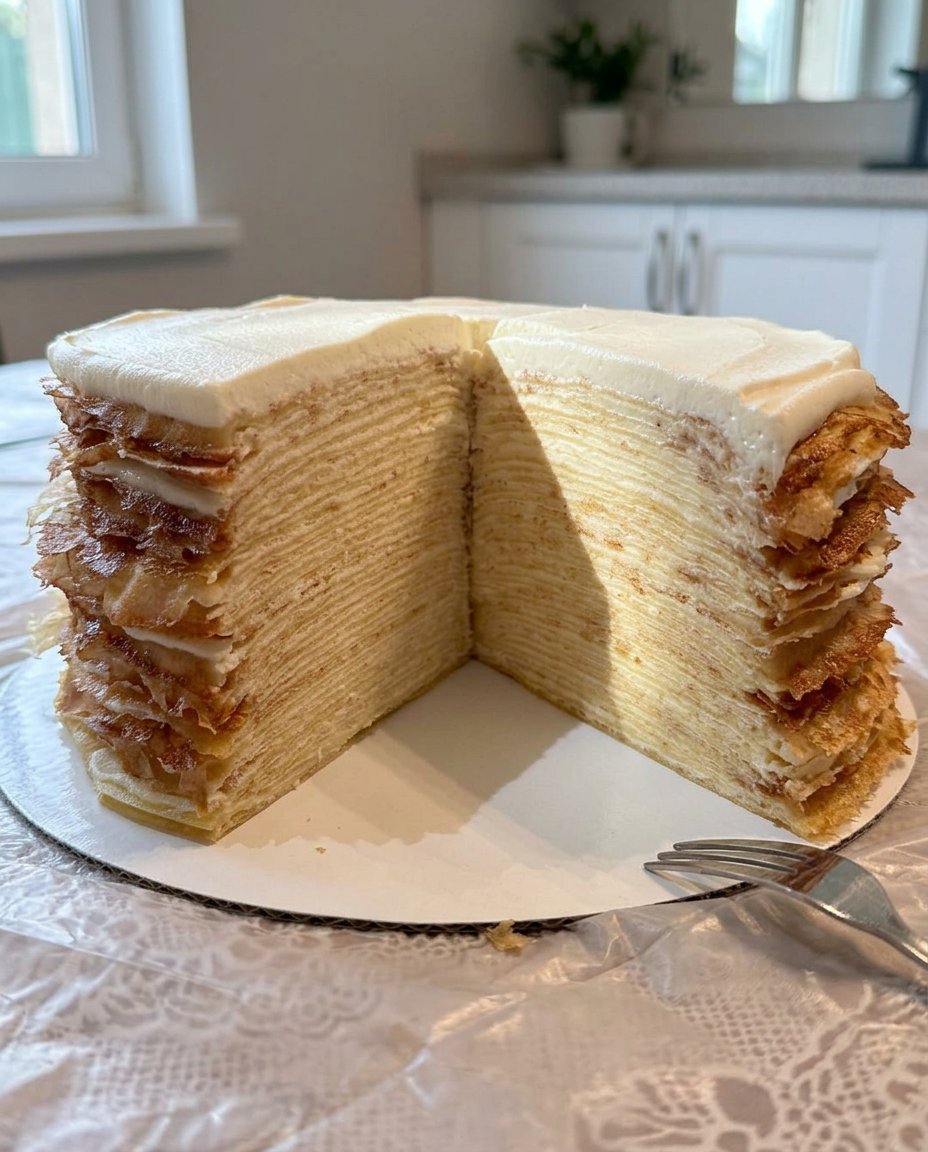
To achieve a consistent result, each ingredient must be treated as a critical variable in the baking equation. Accuracy here prevents the need for troubleshooting later.
- All-Purpose Flour (305g): We selected this for its 10-12% protein content. It provides enough structure to hold the chocolate cream without the toughness associated with bread flour.
- Full-Fat Milk (800ml): The fat in whole milk tenderizes the crepe. We tested low-fat alternatives, but they produced a rubbery texture that lacked the melt-in-the-mouth quality of the original.
- Large Eggs (4): These provide the emulsifiers needed to keep the batter smooth. Always use eggs at room temperature to prevent the melted butter from seizing.
- Double Cream (625ml for filling, 250ml for ganache): With a fat content of at least 36%, double cream provides the necessary aeration and stability to support 20 layers of crepe.
- Dark Chocolate (250g, 70% cocoa): The high cocoa butter content in 70% chocolate confirms the ganache sets firmly at room temperature while remaining silky.
The Step-by-Step Method
Step 1: Emulsifying the Batter
Place the eggs, 800 ml of milk, 80 g of sugar, 305 g of flour, salt, and 25 g of melted butter into a high-speed blender. Pulse for 30 seconds until the mixture is perfectly smooth. This mechanical action breaks down flour clumps more effectively than hand-whisking, leading to a more refined crumb.
Step 2: The Hydration Rest
Let the batter sit for at least one hour at room temperature or overnight in the refrigerator. This rest period allows the gluten to relax and the starch granules to swell. If you skip this, your crepes may be tough and prone to shrinking in the pan.
Step 3: Calibrating the Heat
Heat a non-stick frying pan over medium-low heat. We found that a surface temperature of approximately 325°F (163°C) is ideal. Lightly brush the pan with melted butter. Use a paper towel to wipe away excess; you want a microscopic film of fat, not a pool.
Step 4: Consistent Pouring
Pour exactly 1/4 cup (60ml) of batter into the center of the pan. Immediately tilt and rotate the pan to coat the bottom evenly. Our testing showed that avoiding the sides of the pan keeps the crepes perfectly circular and the edges from becoming too thin and brittle.
Step 5: The Two-Minute Cook
Cook the crepe for 2 minutes until the edges turn golden and start to lift away from the pan. Flip carefully with a palette knife and cook the second side for exactly 30 seconds. Transfer to a flat plate and repeat until all batter is used. You should have at least 20-22 crepes.
Step 6: Preparing the Chocolate Cream
In a chilled bowl, combine 625 ml of double cream, 120 g of icing sugar, and 60 g of sifted cocoa powder. Whisk until stiff peaks form. Be cautious: over-whisking will turn the cream into chocolate butter. The cream should be thick enough to hold its shape when spread but still look smooth.
Step 7: Precision Assembly
Place one crepe on a serving plate. Spread a thin, even layer of chocolate cream (about 3 tablespoons) to the very edge. Repeat this 20 times. Use a small offset spatula to keep the layers level. Refrigerate the cake for 2 hours before adding the ganache to verify the structure is set.
Step 8: The Ganache Finish
Heat 250 ml of double cream until just simmering. Pour over 250 g of finely chopped dark chocolate. Let sit for 5 minutes, then stir from the center outward to create a perfect emulsion. Pour the cooled (but still liquid) ganache over the top of the chilled cake, allowing it to drip naturally down the sides.
Lauren’s Lab Notes
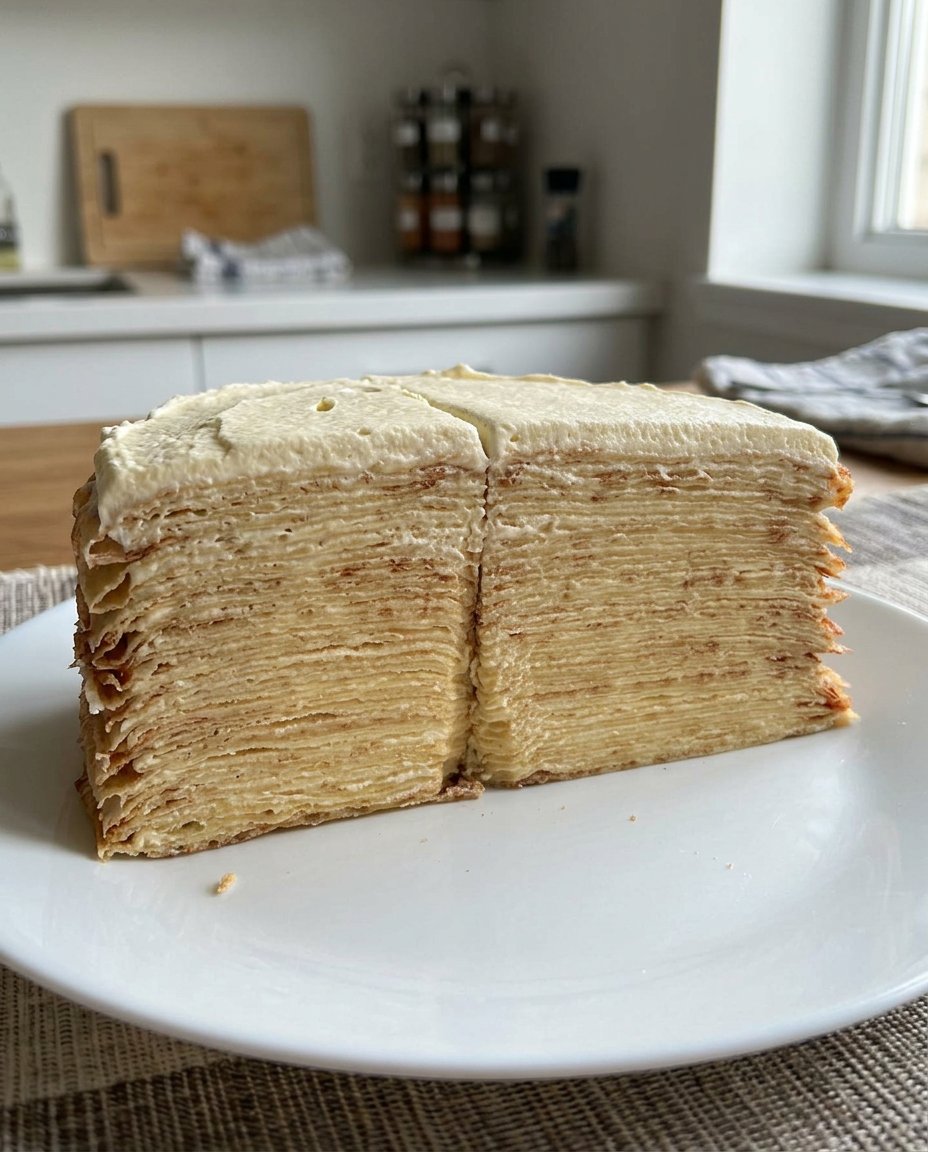
Temperature control is the most frequent point of failure in this recipe. If your crepes are cooking too fast and becoming crispy, your pan is likely exceeding 350°F; reduce the heat immediately. Conversely, if the batter doesn’t set within the first 60 seconds, your pan is too cold, which leads to a pale, leathery texture.
Another critical insight involves the cream’s temperature. Double cream should be between 35°F and 40°F when you begin whisking. If the cream is too warm, the fat globules won’t trap air efficiently, leading to a runny filling that will cause the layers to slide. For more technical guidance on basic cake components, you can review our foundational-recipes guide. Finally, if you want to see a visual breakdown of chocolate ratios, check out this chocolate crepe cake for additional context.
Tested Precision Tweaks
We tested several modifications to the base recipe to see how they affected the structural stability of the stack. If you wish to incorporate fruit, we recommend using a thin layer of seedless raspberry jam every five layers rather than fresh fruit slices, which can create uneven weight distribution.
For those who prefer a brighter finish, applying the techniques from our fresh-fruit-baking guide can transform this into a seasonal masterpiece by adding a crown of stabilized whipped cream and fresh berries on top of the ganache. You can also substitute the chocolate cream for a vanilla bean pastry cream, though this requires a higher concentration of cornstarch to maintain the same vertical height without compression.
Presentation and Stability Notes
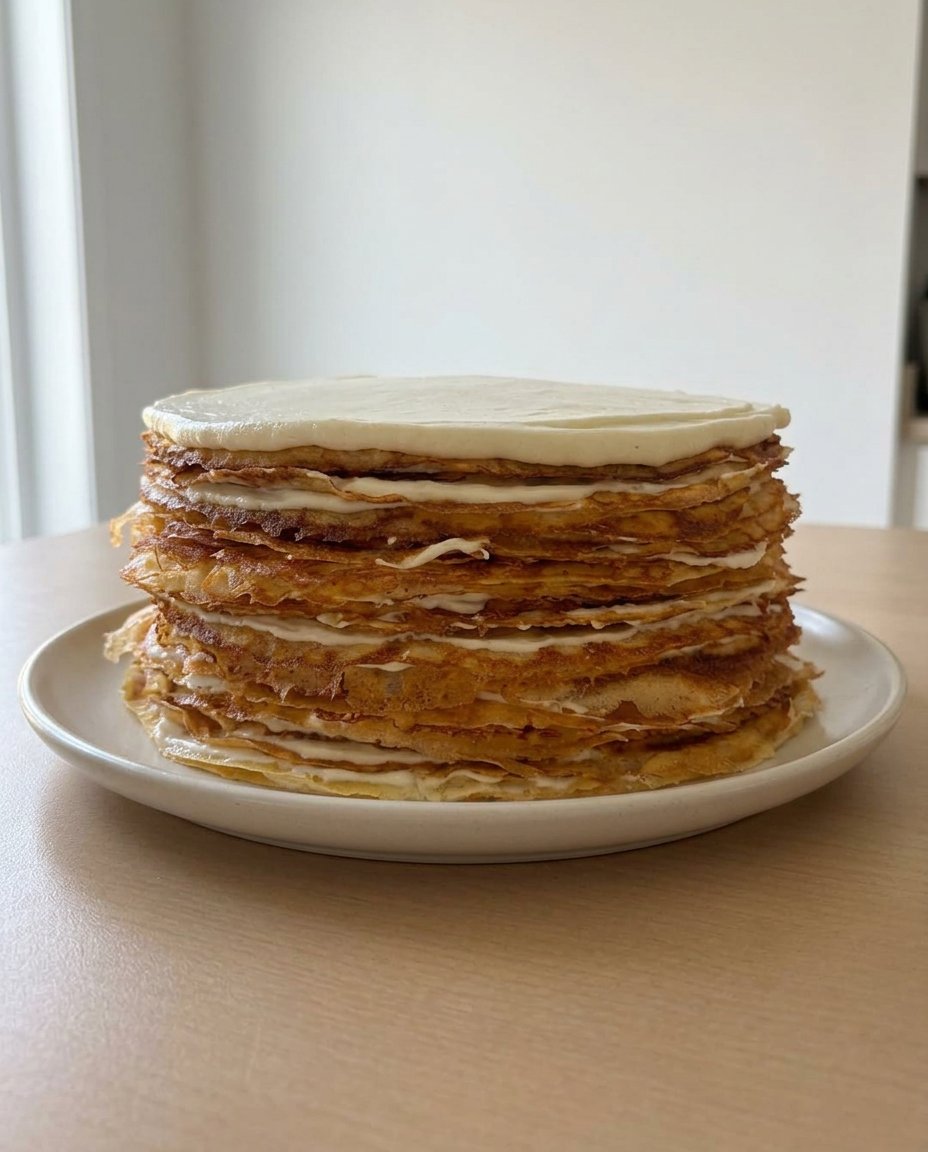
This cake is best served 4 to 6 hours after assembly. This time window allows the cream to slightly soften the crepes, creating a unified texture that is easy to cut with a fork. Use a sharp, thin-bladed knife dipped in hot water and wiped dry between every single cut to achieve the clean cross-sections seen in professional bakeries.
While this cake stands tall on its own, its creamy profile is a great companion to the textures found in our strawberry-tres-leches-cake. We recommend serving each slice chilled, as the ganache and cream lose their structural integrity if left at room temperature for more than 90 minutes.
The Final Analysis
Mastering the Crepe Cake is a breakthrough moment for any baker because it demands a balance of patience and scientific precision. By managing your pan temperature and respecting the hydration time of the batter, you create a dessert that is as stable as it is stunning. As you continue your journey through contemporary-small-format baking, remember that data-driven consistency is your greatest tool. We invite you to share your results with our community of precision bakers. Follow us on Pinterest, Instagram, and Facebook for more lab-tested techniques and baking insights.