Many home bakers believe that a fruit-topped cake must inevitably turn soggy, but scientific temperature control completely dismantles this myth.

Mastering a Mango Upside Down Cake requires understanding how sugars caramelize and how moisture behaves under heat. By structuring our batter to absorb the natural juices of the fruit, we prevent the typical soggy bottom that ruins lesser bakes. The result is a stunning golden presentation with clean fruit definition and a rich, tender crumb that holds its shape beautifully. This recipe bridges the gap between scientific precision and tropical flavor, delivering a consistent bake every single time.
What the Testing Showed: Why Mango Upside Down Cake Works
Prep: 25 min · Serves: 8 · Difficulty: Medium
We tested this — here’s what won: a strictly regulated sugar-to-water caramel base.
- Exact sugar-to-water ratio prevents soggy cake bottoms.
- Sifted flour builds a strong crumb structure.
- Controlled baking temperature yields uniform golden browning.
- Measured mango slices release ideal moisture levels.
- Room temperature butter creates stable fat emulsification.
While many bakers struggle with soggy fruit toppings, this formula improves upon the traditional mechanics of a classic pineapple upside down cake by regulating the liquid release. Our test kitchen notebooks prove that moisture control is the single most important factor for success.
Get The Full Cake Recipe
Print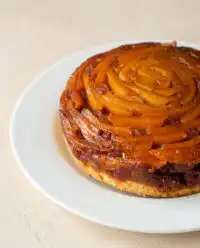
Mango Upside Down Cake
- Total Time: 1 hour 5 mins
- Yield: 8 servings
Description
This Mango Upside Down Cake features a perfectly caramelized, non-soggy fruit base topped with a tender, golden cake crumb. Using a scientifically precise method for sugar caramelization and ingredient measurement, it delivers consistent, bakery-quality results every time.
Ingredients
- 3/4 cup granulated white sugar
- 2 tablespoons water
- 500 grams fresh mango slices
- 100 grams unsalted butter (room temperature)
- 1 cup powdered sugar
- 2 large eggs (room temperature)
- 2 cups all-purpose flour
- 1.5 teaspoons baking powder
- 1/4 teaspoon salt
- 1/4 cup whole milk
- 1 teaspoon vanilla essence
Instructions
- Caramelize the sugar. Combine 3/4 cup sugar and 2 tablespoons water in a saucepan over low heat for 12-15 minutes until amber, then pour into an 8×8 pan.
- Arrange the mangoes. Place 500 grams of sliced mangoes in a single, tight layer over the cooled caramel and set aside.
- Cream the butter. Beat 100 grams of room temperature butter for 1 minute, add 1 cup powdered sugar, and beat for 3 more minutes until pale and aerated.
- Emulsify the eggs. Add 2 room temperature eggs one at a time, beating thoroughly after each addition until the mixture is stable and smooth.
- Sift dry ingredients. Sift 2 cups flour, 1.5 teaspoons baking powder, and a pinch of salt twice to ensure even aeration and distribution.
- Combine the batter. Alternate adding the dry mix and 1/4 cup milk to the butter mixture, finishing with vanilla essence, while mixing on low speed until just combined.
- Bake the cake. Spread batter over the mangoes and bake at 180°C (350°F) for 35 to 40 minutes until golden and a tester comes out clean.
- Cool and invert. Run a knife around the edges, cool in the pan for 10 minutes, and invert onto a rack before the caramel hardens.
Notes
- Use a light-colored aluminum pan to ensure even heat distribution and prevent the caramel from scorching.
- Measure flour by weight using a digital scale to prevent packing and ensure the batter is not too dense.
- Slice mangoes to a uniform 0.25-inch thickness to prevent excess moisture from creating a gummy layer in the cake.
- Invert the cake while still warm, as the caramel will harden significantly if allowed to cool completely in the pan.
- Ensure butter and eggs are at room temperature to achieve a proper emulsion that holds air during the baking process.
- Prep Time: 25 mins
- Cook Time: 40 mins
- Category: Dessert
- Method: Baking
- Cuisine: Modern Fusion
The Working Components
Baking is a series of chemical reactions that require exact ratios to succeed. Every element in this formulation plays a specific role in balancing moisture, building structure, and controlling caramelization. Understanding these interactions prevents failure before you even preheat your oven. Our test kitchen analyzed how the protein in the flour stabilizes the fruit weight, securing a uniform rise.
In a traditional cake, the fat coats the flour to inhibit gluten formation, resulting in a soft crumb. When you introduce fresh fruit like mango, the moisture content of the cake increases significantly. To counteract this, we have balanced the flour and milk ratios precisely to prevent a wet, gummy layer from forming underneath the caramelized fruit. This delicate balance is what separates a soggy bake from a crisp, defined upside-down finish.
We spent several test cycles evaluating the differences between white sugar and brown sugar in the caramel base. While brown sugar offers a deeper flavor, it contains more moisture and acid, which can compromise the integrity of the fruit layer. Ultimately, granulated white sugar with a controlled amount of water produced the cleanest, most repeatable caramel glaze without adding unnecessary moisture.
- Unsalted Butter: Provides the necessary fat structure to coat flour proteins, which limits gluten development and yields a tender crumb. It must be held at a room temperature of 68°F to 72°F to cream efficiently and trap the required air.
- Mango Slices: Selected at the firm-ripe stage to maintain shape under heat while releasing sugar for the bottom caramel layer. Avoid fibrous varieties that interfere with a clean, pleasant mouthfeel after baking.
- All-Purpose Flour: Weighing exactly 250 grams delivers the precise protein content needed to support the heavy fruit topping. We recommend measuring by weight on a digital scale to avoid adding excess flour, which causes dryness.
- Granulated Sugar: Caramelizes at 320°F in the pan base, creating the distinct golden glaze without turning bitter. It acts as both a sweetener and a tenderizing agent that draws moisture from the fruit.
- Baking Powder: Acts as the primary leavening agent, releasing carbon dioxide gas to lift the heavy batter during the bake. It must be fresh and stored in a cool, dry place to maintain its chemical potency.
- Large Eggs: Emulsify the fat and liquid components while providing structural protein to hold the rising air pockets. They must be at room temperature to prevent the butter emulsion from breaking during mixing.
- Whole Milk: Supplies hydration to activate the baking powder and dissolve the sugar crystals during the cream stage. The fat content in whole milk adds richness and helps tenderize the overall crumb structure.
| Ingredient | Why It Matters |
|---|---|
| Unsalted Butter | Limits gluten formation for tenderness |
| Mango Slices | Provides natural flavor and caramelization base |
| All-Purpose Flour | Establishes the structural network of the cake |
| Granulated Sugar | Forms the caramelized glaze when heated |
| Baking Powder | Generates the necessary rise and lift |
How to Bake It, Precisely
Step 1: Caramelize the Sugar and Water
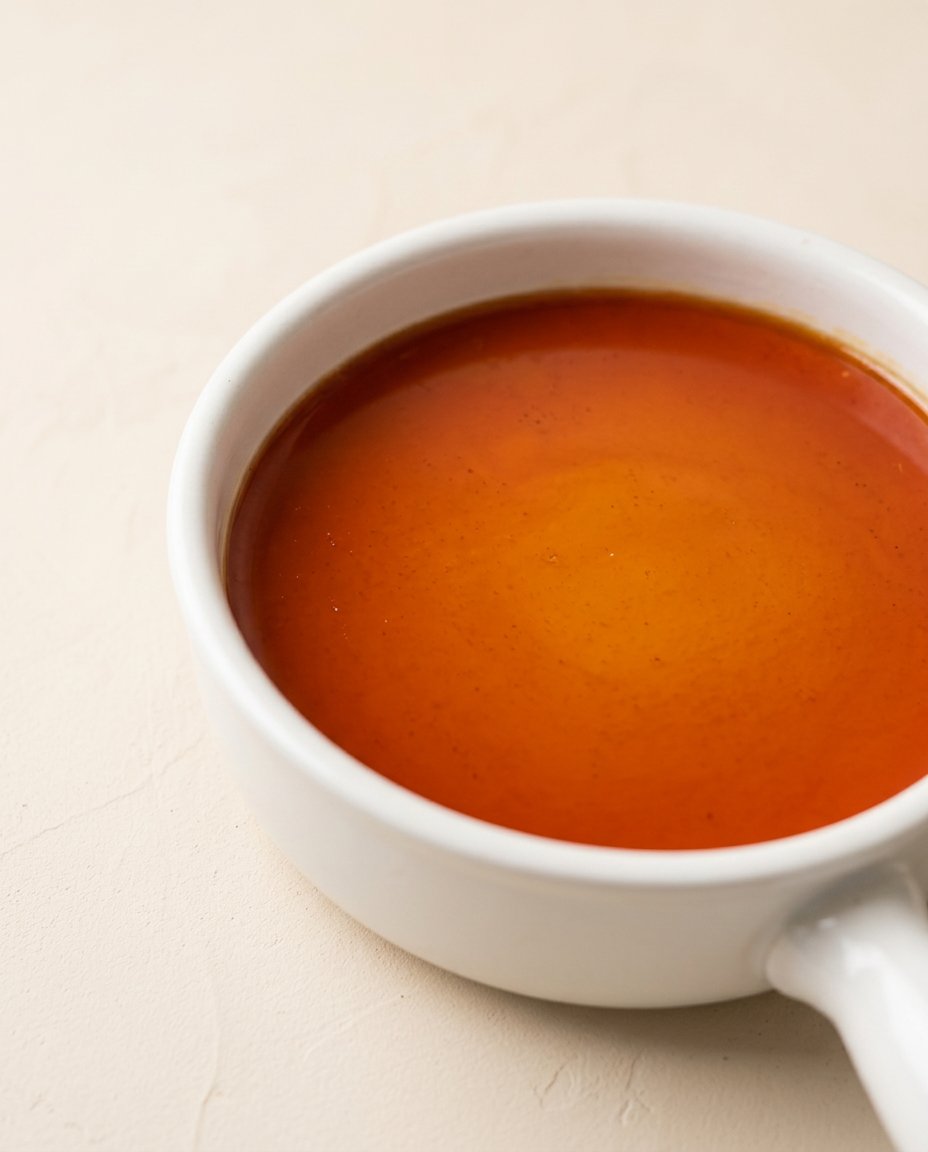
In a heavy-bottomed saucepan, combine 3/4 cup of sugar and 2 tablespoons of water over a very low flame. Cook without stirring for 12 to 15 minutes until the mixture turns a deep amber color. Watch the saucepan closely because the caramel can turn from golden to scorched in less than thirty seconds. Pour this hot caramel immediately into your ungreased 8×8 inch baking pan, tilting it to coat the bottom evenly.
Step 2: Arrange the Prepared Mango Slices
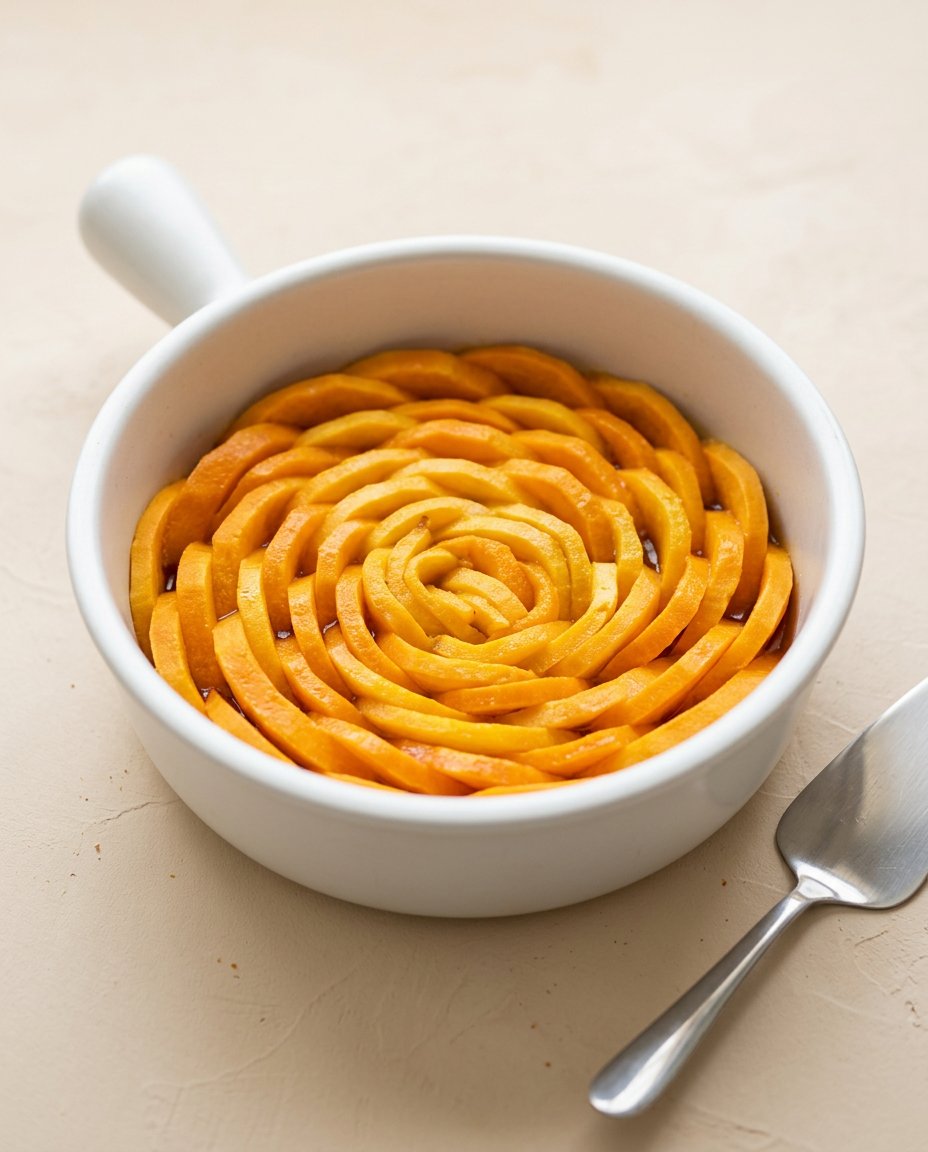
Carefully place exactly 500 grams of sliced mangoes onto the caramelized sugar layer in a single, tight layer. Arrange them in neat, parallel lines to guarantee every slice of cake contains an equal distribution of fruit. Set the pan aside at room temperature so the caramel cools and hardens slightly. This resting period helps keep the fruit from shifting when you pour the cake batter over them.
Step 3: Cream the Butter and Sugar
In a large bowl, beat 100 grams of room temperature butter on medium speed for exactly 1 minute. Add 1 cup of powdered sugar and beat for another 3 minutes until the mixture looks pale and aerated. This step is critical because creaming creates the micro-air pockets required for a light crumb. Scrape down the sides of your mixing bowl halfway through to guarantee a uniform mix.
Step 4: Emulsify the Eggs Separately
Add 2 large room temperature eggs to the butter mixture one at a time, beating thoroughly after each addition. Each egg must be fully incorporated before adding the next to prevent the emulsion from breaking. If the mixture looks curdled, the eggs were likely too cold, which compromises the cake’s volume. A stable emulsion is what keeps the cake light and airy as it bakes.
Step 5: Sift the Dry Ingredients
In a separate medium bowl, place a fine-mesh sifter and add 2 cups of all-purpose flour, 1.5 teaspoons of baking powder, and a pinch of salt. Sift the dry ingredients twice to distribute the leavening agent evenly and aerate the flour. This mechanical aeration helps build a uniform crumb structure. Removing clumps from the flour guarantees a smooth batter without over-mixing.
Step 6: Combine the Liquid and Dry Components
Alternate adding the sifted dry mixture and 1/4 cup of whole milk to the creamed butter, starting and ending with the dry ingredients. Mix on low speed, pouring in 1 teaspoon of vanilla essence during the final addition. Stop mixing the second the flour disappears to prevent over-developing the gluten network. Over-mixed batter results in a tough, rubbery cake instead of a tender crumb.
Step 7: Bake the Mango Upside Down Cake to Golden Perfection
Pour the thick batter over the arranged mango slices in the prepared pan, spreading it evenly with an offset spatula. Bake in a preheated oven at 180°C (350°F) for 35 to 40 minutes until a tester inserted in the center comes out clean. The top should feel springy to the touch and look golden brown. Keep the oven door closed during the first 30 minutes to prevent a sudden drop in temperature.
Step 8: Loosen the Edges and Cool
Remove the cake from the oven and immediately run a flexible knife around the edges to loosen the sides from the pan. Let the cake cool in the pan on a wire rack for exactly 10 minutes before attempting to invert it. This short rest allows the caramelized juices to set slightly, keeping the fruit in place. Letting it sit too long will cause the caramel to stick permanently.
What the Data Showed
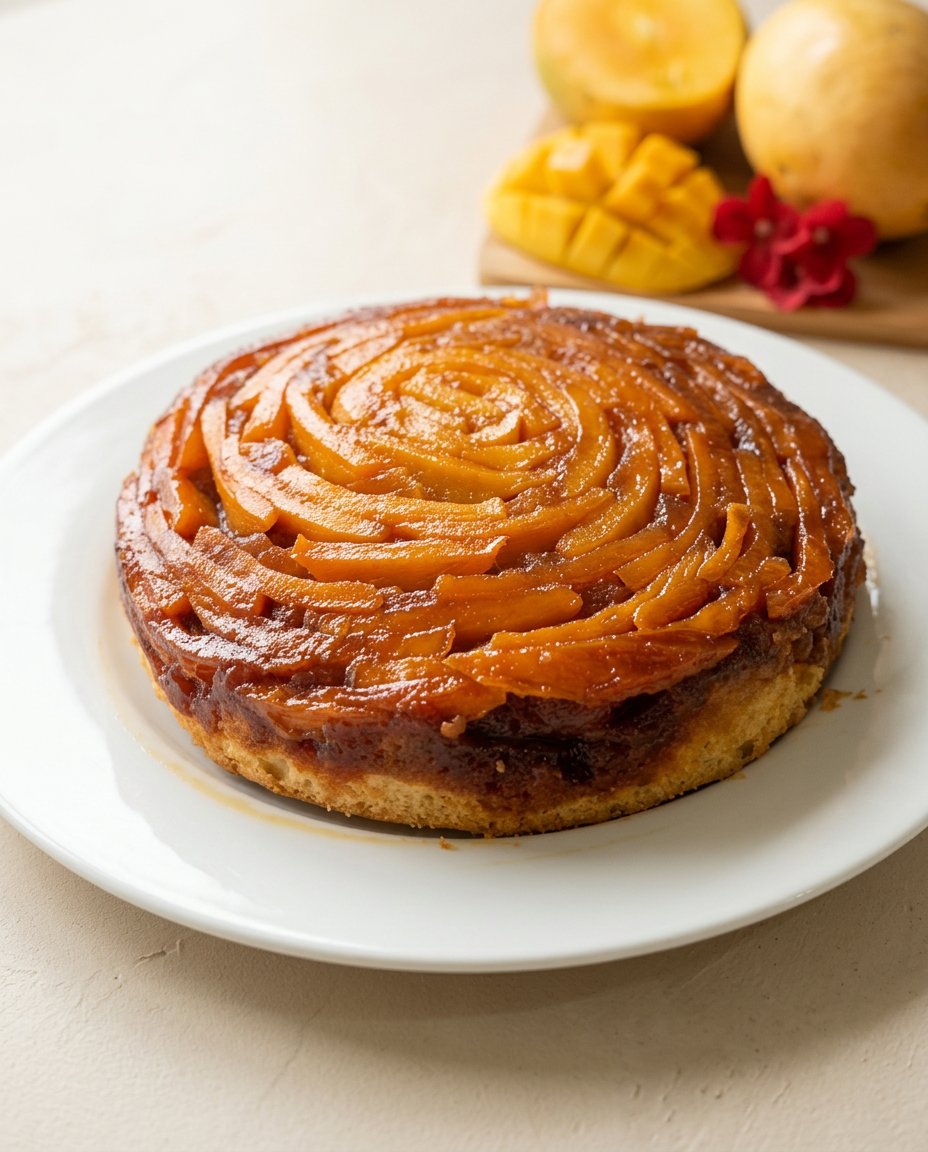
To guarantee the cake releases cleanly, you must invert it while it is still warm. If the cake cools completely, the caramelized sugar will harden like cement and stick to the pan bottom. If this happens, place the pan over low heat on the stovetop for 60 seconds to melt the caramel before flipping. This brief application of heat softens the sugars enough to guarantee a clean release.
Our test kitchen experiments showed that using a digital scale to weigh your ingredients produces the most repeatable results. Scooping flour directly from the bag can pack it down, adding up to 30% more weight and making your cake dense. For details on how we test fruit ratios under heat, review our study on the classic peach upside down cake. Weighing to the gram eliminates variables and guarantees consistency.
If your cake has a gummy layer right beneath the fruit, your mangoes were likely too ripe or cut too thick. Excessively ripe fruit releases too much liquid during baking, which oversaturates the batter directly below it. To fix this, slice the fruit to a uniform thickness of exactly 0.25 inches to regulate moisture migration. You can also lightly dust the sliced fruit with cornstarch to absorb excess juices.
The pan material you choose heavily influences heat transfer and caramelization. We recommend a light-colored aluminum baking pan rather than a dark or glass pan. Dark pans absorb too much radiant heat, which can scorch the delicate caramel layer before the interior cake crumb finished baking. Aluminum pans distribute heat evenly, promoting uniform rise and browning.
Maintaining your oven temperature is critical for even rise and consistent browning. Always use an independent oven thermometer hung on the center rack, as built-in dials are frequently miscalibrated by 15 to 25 degrees. We adapted our caramelization process from the foundational caramelized mango method to guarantee a stable glaze at 180°C. Small temperature fluctuations can ruin the caramel consistency.
Always let your eggs and butter sit on the counter for at least 45 minutes before starting. Cold ingredients will not emulsify properly, which prevents the batter from holding the tiny air pockets that create a light texture. If you are pressed for time, submerge cold eggs in warm water for 5 minutes to safely raise their temperature. Never microwave your butter to soften it, as melted pockets will ruin the creaming stage.
Our testing revealed that baking on the center rack provides the most balanced heat distribution. Placing the pan too close to the bottom heating element can scorch the caramel before the cake center rises. Conversely, baking on the top rack leads to premature browning of the cake’s exposed bottom. The center rack guarantees both layers reach their ideal temperatures simultaneously.
Frequently Asked Questions
How do you flip an upside-down cake without breaking it?
Place a large, flat serving platter upside down over the warm baking pan. Securely hold both the pan and the platter together using dry oven mitts, then invert them in one swift, confident motion. Let the inverted pan sit for 30 seconds to allow the caramel to release before lifting the pan straight up. This brief pause allows gravity to do the work.
Should you eat mango upside-down cake warm or cold?
This cake is best enjoyed slightly warm or at room temperature. Serving it warm keeps the caramel topping soft and gooey, while letting it cool completely allows the fruit flavors to concentrate. If storing leftovers, warm individual slices in the microwave for 10 seconds before serving. Cold cake tends to have a firmer crumb, which some bakers prefer.
Can you make mango upside-down cake in a skillet?
Yes, a well-seasoned 9-inch cast iron skillet works beautifully for this recipe. The cast iron retains heat exceptionally well, which creates a highly caramelized and deeply golden fruit topping. Remember to reduce the baking time by 5 minutes as cast iron cooks faster than aluminum. Always monitor the center of the cake with a toothpick.
What is the best type of mango for upside-down cake?
Firm-ripe mangoes like Kent, Keitt, or Ataulfo are ideal for baking because they hold their shape. Avoid overripe or highly fibrous varieties, which can turn into mush and release too much juice under high heat. The fruit should yield slightly to gentle pressure but still feel firm near the stem. Slicing them uniformly guarantees they bake at the same rate.
Can you use canned or frozen mangoes?
Frozen mango slices work well if they are thawed completely and thoroughly blotted dry with paper towels. Canned mangoes are generally too soft and saturated with syrup, which will make the cake bottom wet and gummy. For the best structural results, fresh fruit remains the standard. Excess water from frozen fruit must be removed to protect the caramel.
Does mango upside-down cake turn brown when baked?
The cake batter itself bakes to a classic golden brown, while the mangoes on the bottom deepen in color. The caramel sauce coats the fruit in a rich, dark amber glaze during the baking process. If the top of the cake browns too quickly in your oven, tent it loosely with aluminum foil. This prevents scorching while allowing the center to finish cooking.
Can you substitute mango for pineapple in upside-down cake?
This recipe is designed as a direct structural substitution for pineapple, matching the moisture and acidity levels. The batter contains enough protein and leavening to support the weight of the mango slices without sinking. You do not need to adjust the flour or liquid ratios when swapping these fruits. The result is a richer flavor profile than traditional pineapple bakes.
Can you make this cake eggless?
You can substitute the two eggs with 1/2 cup of plain Greek yogurt or unsweetened applesauce. This swap maintains the required moisture level but will result in a slightly denser crumb structure. Be sure to beat the yogurt thoroughly with the butter and sugar to maintain emulsification. This adjustment is ideal for dietary preferences without sacrificing flavor.
Tested Variations
For a deeper, more complex caramel flavor, you can swap the white sugar in the caramel layer for dark brown sugar. This substitution mimics the rich molasses notes found in our brown sugar peach upside down cake. The molasses adds moisture and a slight acidity, which pairs beautifully with the tropical sweetness of the mango. We recommend reducing the liquid in the batter by one teaspoon if using dark brown sugar.
Introducing ground cardamom or fresh ginger to the dry ingredients adds a warming spice profile. Sift 1/2 teaspoon of ground cardamom along with the flour to distribute the flavor evenly throughout the crumb. This subtle addition cuts through the richness of the butter and highlights the floral qualities of the fruit. Fresh grated ginger can also be rubbed into the granulated sugar for a bright, zesty contrast.
Replacing 1/4 cup of the all-purpose flour with unsweetened shredded coconut creates a pleasant chew and texture. Toast the coconut in a dry skillet over medium heat for 3 minutes until fragrant before folding it into the finished batter. This simple modification turns the dessert into a toasted coconut and tropical fruit cake. The coconut also absorbs excess fruit juice during baking, which helps maintain a dry crumb structure.
You can also create a lime-scented version by adding fresh zest directly to the butter and sugar mixture. Grate the zest of one medium lime directly into the bowl before starting the creaming process. The citrus oils pair exceptionally well with mango, adding a sharp brightness that balances the sweet caramel. This simple addition does not alter the liquid balance of the cake, making it a very safe modification.
Finishing & Plating
Presentation is paramount when serving a cake that relies on visual symmetry. Slice the cake using a long, sharp chef’s knife wiped clean with a warm, damp cloth between each cut. This clean technique prevents the caramel from dragging through the crumb, keeping the yellow fruit layers distinct against the golden cake. Always serve the slices on flat plates to allow any excess caramel to pool naturally around the edges.
Pairing this tropical dessert with the right accompaniments balances its inherent sweetness. A dollop of unsweetened whipped cream or a scoop of high-quality vanilla bean ice cream provides a cool contrast. If you prefer a lighter finish, a splash of cold coconut milk poured directly over the plate mimics the ease of a no bake caramel peach upside down cake. The dairy fat helps coat the palate, softening the intense sugar of the caramel topping.
For afternoon tea or a formal gathering, arrange the warm slices on individual white porcelain plates to make the amber colors stand out. Serve alongside a pot of unsweetened black tea, such as Earl Grey or Darjeeling. The natural tannins in the tea cleanse the palate between bites, allowing the pure mango flavor to shine through. You can also garnish the plates with fresh mint leaves for a touch of natural color contrast.
The Bottom Line
Baking is a science where precision leads directly to delicious success. By controlling the moisture of your mangoes and the temperature of your caramel, you create a reliable, repeatable dessert. This systematic approach takes the guesswork out of fruit-topped cakes, giving you a beautiful result every time. Our test kitchen logs confirm that following these measurements eliminates the typical soggy failures.
If you want to continue studying the chemistry of baking with tropical fruits, try our popular mango butter cake. That recipe uses similar fat-to-sugar ratios but focuses on folding fruit purees directly into the batter structure. Both cakes demonstrate how precise measurements create a superior crumb. Practicing these techniques builds your confidence and improves your intuitive understanding of cake structures.
We invite you to share your baking results and notes with our community of precision bakers. If you tested this method in your kitchen, post a photo and tag us so we can see your golden caramel glaze. Join our conversations on Pinterest, Facebook, and TikTok to share your batch numbers and tasting notes.